EPLUSEPLUSAI · IoT · Vision · Software

APPLIED AI · IoT · VISION

From data to decisions. From the field to value.

We analyze changes captured by sensors and images captured by cameras. EPLUS develops AI solutions that connect data collection, model training and inference with operations and business systems.

EPLUS / APPLIED INTELLIGENCE01 — 02
01 / IoT INTELLIGENCE

TasumHouse AI

Sensor signal analysis

ESP32→AI MODEL→INSIGHTS
02 / AI VISION

eVision AI

Product image classification

CAMERA→YOLO11→OK / NG
DATA · MODELS · OPERATIONSIoT × VISION
FIELD DATAWi-Fi CSIIsolation ForestYOLO11PySide6MODEL OPERATIONS

ESG · LOCAL LLM · RAG · MANUFACTURING

An ESG · AI toolbox for manufacturers

A practical collection for energy, carbon and equipment-efficiency calculations, ESG checks, source-grounded questions and manufacturing document drafts.

01 / OLLAMA · QWEN3 4B

Local AI with Ollama

The published implementation uses an Ollama local LLM for manufacturing and ESG questions and drafts for work standards, quality improvement, equipment checks and ESG reports. Qwen3 4B runs on a separate AI PC without calling a paid external AI API.

02 / BGE-M3 · SQLITE · RAG

Document RAG with BGE-M3 and SQLite

Registered ESG guidelines and supply-chain references are embedded for retrieval. Relevant passages are searched for each question and supplied to the local LLM as context. Answers include document names and page references for source review.

03 / PYTHON · FLASK · TAILSCALE

Web service separated from AI runtime

The implementation places the Python/Flask web API and the Ollama/RAG runtime on separate PCs, connected through a private Tailscale network. The technical articles describe separating the public web surface from internal AI processing.

  1. 01Ask a question
  2. 02Retrieve ESG passages
  3. 03Answer with local LLM
  4. 04Review cited sources

AI responses and document drafts are references for review. Staff should verify original sources, operating conditions and applicable criteria before use.

01 / SOLUTIONS

Two ways to put AI to work

IoT for changes in a space. Vision for product quality. Different data, connected through an operational perspective.

IoT INTELLIGENCE

TasumHouse AI

AI that reads environmental change
ESP32Wi-Fi CSIV2 MODEL

An integrated IoT platform that collects Wi-Fi CSI, temperature and humidity and analyzes unusual signal patterns. Customers, sites, locations and devices are organized with access permissions.

  • ESP32 · MQTT sensor collection
  • V2 activity/night model training and versioning
  • Feature generation and inference about every 5 minutes
  • Map monitoring · collection, training and job status

Anomaly scores describe environmental signal changes. They do not establish movement, falls, sleep states or medical risk.

AI VISION INSPECTION

eVision AI

Quality inspection trained per product
YOLO11LOCAL AIOK / NG / HOLD

The Python/PySide6 eVision AI desktop app trains product-specific OK/NG image classifiers and publishes validated models to NAS. Desktop and esgit.co.kr web inspection apply product models, connect results to MES records and NAS photos, and make inspection history and quality summaries available in eMESLite.

  • Train and version product-specific YOLO11 image classifiers on PC
  • Publish the active validated model to NAS with SHA-256 integrity checks
  • AI or manual OK/NG/hold decisions from desktop and web
  • MES quality records · NAS inspection-photo retrieval
  • eMESLite item summaries · daily inspection trends

This describes the implemented integration flow. Classifications and confidence must be validated against inspection criteria and real operating data; retraining alone does not guarantee better performance.

EVISION AI × ESG·AI WEB × EMESLITE

A connected quality workflow from training to history analysis

Publish product models trained on PC to NAS, then use them in eVision AI desktop and esgit.co.kr web inspection. Results are saved to MES quality history, related photos stay on NAS, and eMESLite provides history and quality analysis.

  1. 01eVision AI · Train product OK/NG models
  2. 02NAS · Publish validated model
  3. 03PC / esgit.co.kr · AI or manual inspection
  4. 04MES + NAS · Results and photos
  5. 05eMESLite · History, item and daily analysis

Web AI decisions and shared inspection history require a MES account and the connected operating environment. Local PC records are distinct from MES-linked records.

02 / HOW WE BUILD

One flow from collection to operation

For model outputs to serve real work, data quality, decision criteria and operating records must be designed together.

  1. 01

    Collect

    Sensors · Images

    Define installation and capture conditions to obtain usable data.

  2. 02

    Train

    Data · Models

    Separate data by product and environment and manage model versions.

  3. 03

    Decide

    Inference · Validation

    Present scores and classifications for review against field criteria.

  4. 04

    Operate

    Records · Workflow

    Record processing status and results and connect them to dashboards and work.

03 / RESPONSIBLE OPERATIONS

AI with visible operations

Designs expose data freshness, model versions, processing status and decision records alongside results.

Data quality
Check delays, valid data, image clarity and labels
Human review
Review ambiguous or low-confidence results
Continued validation
Revalidate after changes to location, lighting or products

04 / ENGINEERING JOURNAL

Technology, documented as we build

Read about implementation, current features and future directions on IT Manmulsang.

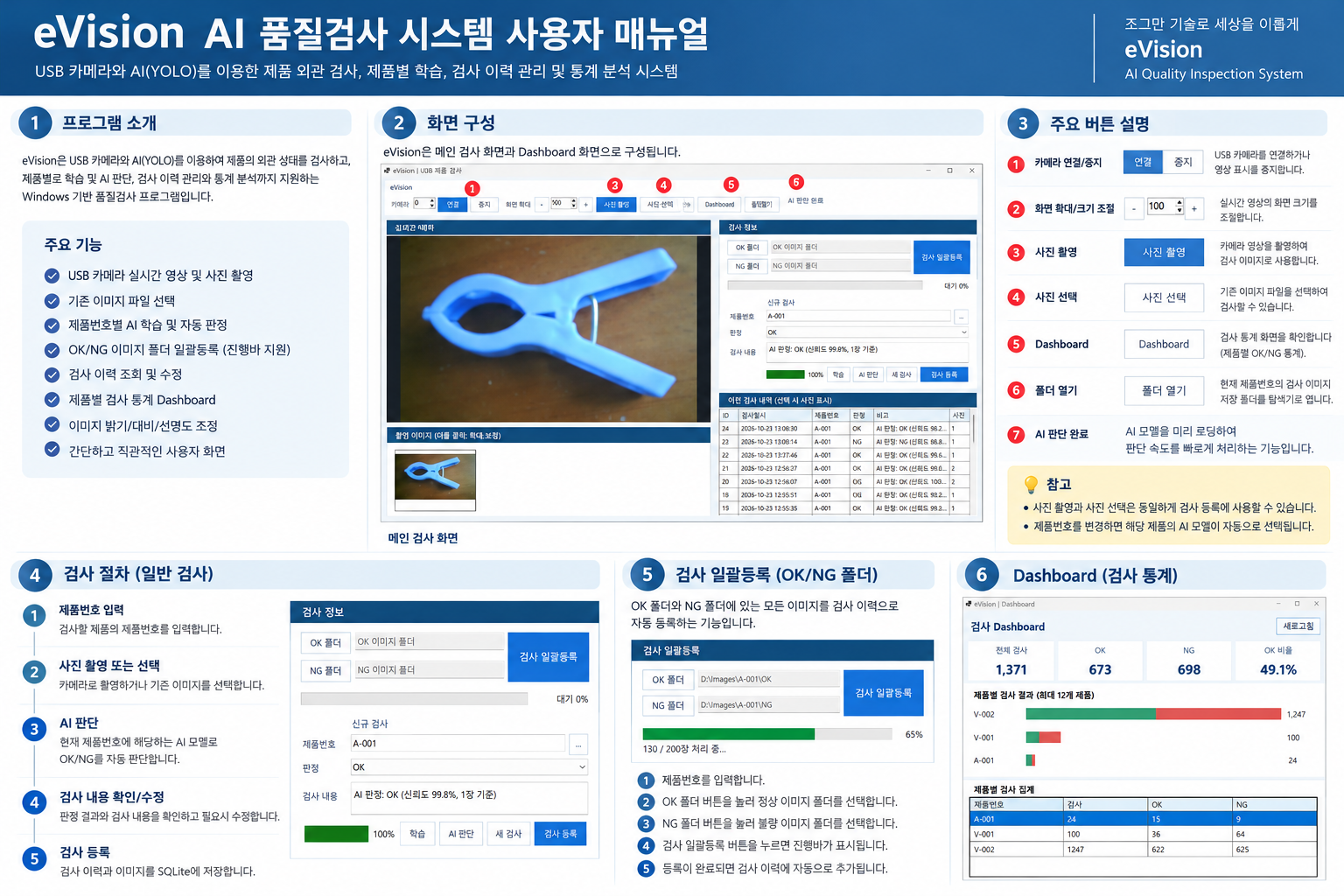
Early Windows version manual+

This reference shows the original C# WinForms interface. See the development article for the current Python/PySide6 version.

Open full-size manual ↗Early Windows version manual

LET’S BUILD WITH AI

Where could AI help your operation?

We review your data, inspection criteria and existing systems to define a practical scope together.

Discuss AI adoption ↗